Most boards don't need an AI strategy. They need a position. We help yours write one that survives audit, regulator, and the next CFO budget review. And identifies the two or three places AI actually deserves your capital this year.
We don't talk about AI in theory. We run an internal R&D programme: gated pilot lifecycle, versioned prompts, evaluation suites, eval gates before any prompt change, structured logs, AWS budget alerts. The same governance machinery we install for clients is the machinery we run on ourselves.
We're CIOs, not AI specialists. The position has to fit your IT operating model, your security posture, your compliance trajectory, and your CFO's view of OPEX. AI consultancies that haven't run an IT P&L tend to miss at least one of those.
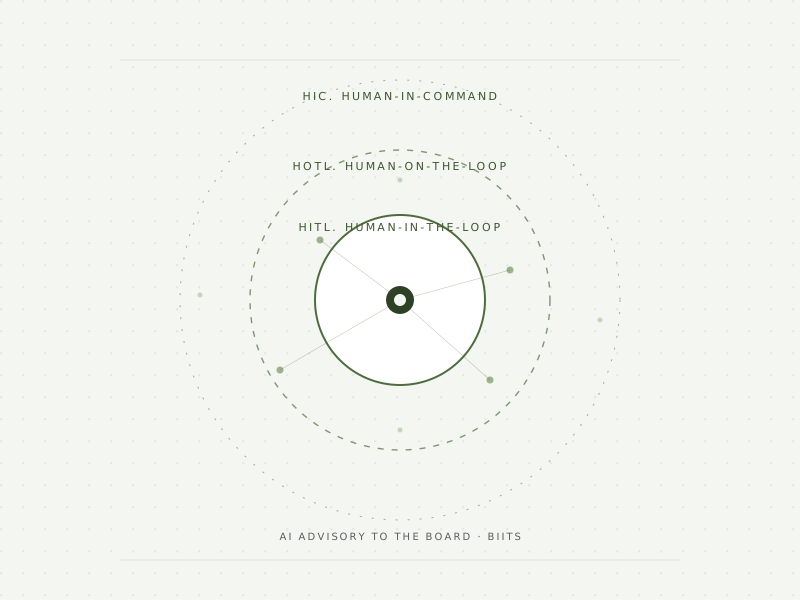
Every AI use case in your business sits in one of three modes. The board's AI position must name which mode applies where. Mixing them up is the most common governance failure we see.
The human sits inside the decision chain. The system cannot act without explicit human approval per action.
Use it for: financial commitments, HR decisions, customer contracts, security actions.
Trade-off: highest control. Lowest speed.
The human sits above the chain as supervisor. The system acts autonomously. The human monitors actively and can intervene or stop at any moment.
Use it for: operational automation, monitoring alerts, routine integration flows.
Trade-off: balance between speed and control.
The human sits in front of the chain. Sets the strategy, policy, boundaries, and kill-switches. Does not intervene operationally. The system runs within those frames; review happens after the fact via audit trails.
Use it for: high-volume, low-risk automated processes.
Trade-off: highest speed. Requires strong post-hoc governance.
Competitors talk about AI. Customers ask what your AI position is. Auditors want to know which controls apply. The EU AI Act lands in stages.
Three internal initiatives running in parallel. None with an owner senior enough to kill them. None with an evaluation framework anyone trusts.
Tools you haven't decided you need. Demos that drove timeline. Procurement is tracking spend you can't yet justify on the board pre-read.
We don't sell pilots. We don't sell prompts. We don't sell vendor relationships. We sell the position itself, and the discipline behind it.
No invented frameworks. The same gates we use in our own R&D programme.
What AI is already running in your business. Sanctioned, shadow, or vendor-embedded. Who owns it. What it's costing.
EU AI Act applicability per use case. NIS2, GDPR, sector-specific rules. Customer contract obligations. Insurance position.
Where AI actually deserves capital this year. Justified against P&L, not against competitor announcements. Everything else: sunset or defer.
Pilot lifecycle gates, evaluation framework, prompt versioning, cost monitoring, human-in-the-loop policy.
The single document the board adopts. Written so non-technical directors can defend it in front of auditors and shareholders.
To the executive accountable internally. We don't stay to "support adoption". The position should be operable by your team on day 71.
Single source of truth, board-adopted, audit-ready. Six to ten pages. Defensible to auditors and shareholders.
Every AI initiative ranked by risk, value, and regulatory fit. Quarterly review template included.
Pilot lifecycle gates, evaluation template, prompt-versioning standard, cost-monitoring set-up.
EU AI Act tier per use case. NIS2 / GDPR / sector overlay. Insurance position.
What you've already signed for. Where you have room to renegotiate. Where you're locked in.
For the executive who runs it after we leave. Working binder, not a deck.
Smaller, faster, and we do the writing ourselves. A Big-Four engagement gives you a 60-page deck and a senior partner who shows up at the readout. We give you a 6 to 10 page Position document the board adopts, plus the governance kit you need to operate it.
No. We define the position, the controls, and the governance. We don't take vendor commissions, we don't bundle implementation, and we don't have a pet platform we're trying to get you onto. This is by design.
Built into Gate 02. Every use case is classified against the Act's risk tiers, with the obligations that apply. Where the Act is silent or still being clarified, we say so explicitly.
No. The first thing we do is inventory what's running, sanctioned and otherwise. Some of it will pass review. Some won't. The Position document tells you which is which.
The CEO or board chair to sponsor it. The CFO and General Counsel for the regulatory and budget conversations. The CIO/CTO and CISO for the operational reality. Plus whoever inside the business is closest to the use cases under review. Total time per executive: 4 to 6 hours over the engagement.
Fixed scope, fixed fee. We share the price after the intake call, once we know the size of your AI footprint, the regulatory complexity, and how many use cases need ranking.
Leave with a six-week plan to finish it.